Showing posts with label Mandarin Duck. Show all posts

Wednesday, 23 April 2014

Spring has arrived...

Spring has arrived! The days are longer and warmer, and the light is (usually) better. Slowly we're getting used to the change in the seasons - it's not just how we feel about Spring; it's the gradual disappearance of the winter wildfowl, and the excitement of the reappearance of old friends.
Here we have Black-tailed Godwits in their breeding plumage, showing off their red heads and breasts. In the middle of a long row of council houses is a gate leading to the allotments - and to a large scrape where these Blackwits roost over high-tide, sometimes almost a thousand of these large waders. Alongside the scrape is a local nature reserve, with pond, a wooded area, and (that rarest of things) a scrub area, with gorse, brambles, and small trees; just what is needed for warblers.
 
Happily posing for us near Leasowe is this common warbler - a chiffchaff. These can be present all year round, but really make their present felt when they begin singing their distinctive song. Really they should be called chiff-chiff-chiff-chaff-chiff-chaff-chaff-chiff's, but that's a bit of a mouthful.

And shortly after the chiffchaff begin to sing, the wheatears start to pass through. They stop off in the horse paddocks as they rest during their journey northwards.
 
Ranging a little further afield ourselves, we headed off to the Great Orme, a delightful place to see sea birds, and then on the plateau there all sorts of migrating birds passing through, as well as a wide selection of  scavengers.
Here we have a Jackdaw, checking out the area around the cafe. These intelligent birds are highly social, and are usually found in groups. Great Orme also hosts the Chough, another member of the corvid family, with a thin red beak that is used to probe the soil; when I get a decent picture, it'll appear here, I promise!

During the spring migration, the plateau is often full of resting migrants, here a male Stonechat. I don't think I've seen so many stonechats in one place before, often seen perching on a higher twig above the scrub to watch what is happening around. Meadow pipits are another common visitor at this time of year.

Listen carefully near the cliffs, and you may hear a low 'gronk' noise; not the chatter of the Jackdaws, not the angry 'craw' of the crow. This is the sound of a much beefier bird, the raven, largest of the corvid family. Usually seen soaring in the sky, I managed to find this one perched on top of a cliff overlooking the road.
 
Returning closer to home, in the last ten days or so, we have the joy of seeing a pair of Gagraney arrive at our local RSPB reserve. Usually they are only present for a say or two as they pass through, but this pair seems quite settled - perhaps they will stay, and breed here. Only time will tell. The male especially is highly distinctive with the grey side panel and bright white curved eye stripe. Head on the effect is quite dramatic, and the bird really stands out.

Meanwhile, overhead soar a pair of buzzards, softly 'mewing' as they go by. While they will take smaller birds, buzzards generally look for something to scavenge, the same kind of diet as the corvids, which does mean they are in competition, and can lead to corvids mobbing buzzards and other birds of prey, trying to force them from the area. In this case all was calm, and we could enjoy the view of this pair lazily scanning for supper.
 
Another spring returnee is the blackcap. Very distinctive once seen, the male has a black top, while the female has a brown top. They make a call somewhat like two stones being tapped together.

When we go Martinmere, the local WWT centrw, we usually keep to the 'wild' side of the reserves. Recently, though, we went there with some friends, a perfect excuse to spend some time looking through the 'captive' side of the centre.
Here we found some Baikal Teal, a brightly marked bird from the far east. Over winter one was seen on the Southport marshes, resulting in a lot of interest. The jury is still out as to whether it was a genuine wild bird, or an escapee from a private collection.

Equally well decorated is this male Mandarin duck. These dapper ducks are not native to this country, but sufficient have escaped and bred that there is a small but established population, and can be found locally.
The delight of the trip was this African gry-crowned crane - his fuzzy head gear looked most impressive, and gave him an expression of curiousity that matched how we felt looking at him!

Thursday, 30 May 2013

More Spring ... and some of the results

Even though we're still seeing wet days, there's no doubt that Spring is now in full swing. Indeed, there are some signs of Summer (sshhh... don't say it too loudly). The reed beds have been full of loud scolding rattles as Sedge Warblers stake their claim for territory. While they are often heard, usually if they're seen at all it is as a fast-moving blur dashing through the reeds. Here's two snatched shots, note the prominent white eyebrow (supercilium, to use the technical term).

 
Other migrant visitors include these flycatchers. The first a Pied Flycatcher, seen at Penyschant, near Conwy, and well worth a visit for a quiet few hours. These were seen flying in pairs at high speed around and through trees, the female playing 'catch me if you can' with the male. The second is a Spotted Flycatcher, seen at Pagham Harbour, darting from it's branch to hover almost like a hummingbird as it plucked flies from the air, and then back to it's perch.

Other birds are resident all year round, but still make a pleasing sight. This a Goldfinch rummaging through the grass for seeds.
The grey Heron is also a resident, and a firm favourite of mine. This one trying his best to do a 'Darth Vader' impression early one morning.
Spring of course means one thing: lots of squeaking, squawking, quacking, and flapping of wings. This particularly indiscreet couple were flagrantly performing at Arundel WWT.
Obviously they weren't the only ones as all around the grounds there were signs of new life. Goslings, Coot and Moorhen chicks. One proud Mallard Mum even took her chicks for a tour of one of the hides
And if you think it's just the birds at it, here's some lambs too!
And as the month has moved on, we've started getting Summer visitors too, Swallow, Swifts and Martins joining the throng. This Swallow was also inspecting the inside of a bird hide, making for an easy photo, while the following Swift was much harder work, needing dozens of shots to get one passable view.

 A trip to the Great Orme was worth all the Bank-holiday traffic problems when it yielded Chough's, an uncommon member of the corvid family, related to rooks, crows etc.
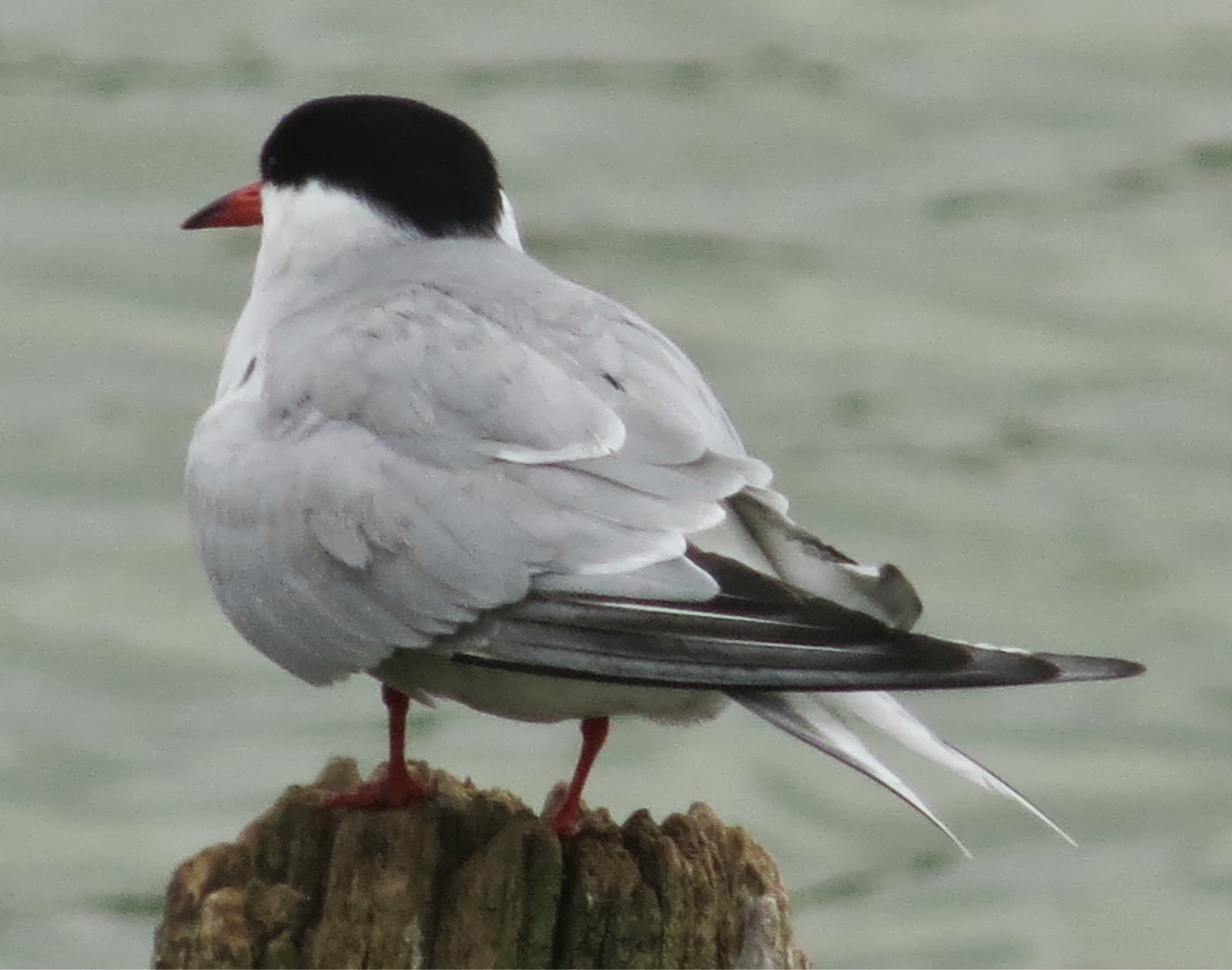
 And sea-level has provided some new birds too, this a Common Tern, posing on a fence post at one of the pools at Arundel WWT.
 Arundel also provided this shy little Mandarin duck, tucked away in a wooded area. Is this an escapee from the 'captive' part of WWT, or a genuine wild bird? Don't know! Either way, it was a very pleasant sight.

Nearer to home, RSPB Burton Mere Wetlands also delights. This Wood Sandpiper dropped in for a morning visit, causing quite a stir - it should have already been up in it's Artic breeding grounds, another casualty of the late spring.
 Also at Burton Mere, this Willow Warbler delighted with some lovely views, including this one with flies caught in it's beak.
 Again at Burton Mere, we were treated to a visit by a stunning female Marsh Harrier. Unfortunately the Black-headed Gulls took exception to her presence, and mobbed her across the reserve.
And finally, I finish again with another common bird, but I couldn't resist the pose of this Chaffinch, this taken at Frodsham Marshes.