We've been out as often as we can in the latter part of the year. With the very mild weather through end of October to end of December, there have been all sorts of sightings/ Perhaps the strangest looking was this hoopoe near Rhyl. There's something about it's eyes that make it look like a stuffed toy, but I assue you it was moving around ! I've seen a similar effect in other people's photoes too, so it's not just my camera, though as usual I had to push the zoom right out to get this shot.
Distance wasn't the problem with this Tawny Owl at WWT Martin Mere; just seeing it was hard enough. As we walked around one Saturday we came across around a dozen people staring up in a tree. Obviously something was there, but it took a minute or so to get the eyes focussed in... There, in broad day light, straight above one of the main paths, this owl was quietly sitting. I wonder how many people had already walked straight past, as I'm sure we would have as well, had not one sharp-eyed birder picked out the shape in the leaves.
Another hard set of pictures, were of this Willow Tit at Woolston Eyes. Not distance, nor camouflage this time, but sheer restlessness/ We had gone here in the hope of seeing this increasingly uncommon bird, but it caught us quite by surprise. My first reaction was to scribble down Coal Tit, 'cause it hasn't got the white mark on the back of the neck... WAIT A MINUTE, it's the Coal Tits that have the white mark !!! Quick, grab another loook, but too late, it had gone.... Twenty minutes later, amid all the Blue Tits, Great Tits, Greenfinches and Reed Buntings feeding, there's a flicker of a smaller greyer bird - and just time to snatch a couple of shots before it again flitted away... Still, a great feeling to have seen it, and it underlines the importance of places like Woolston, where wildlife can take precedence... Without being too political, this current Government is utterly failing in it's claim to be 'green'. While I'd support the concept of HS2, it needs far more careful routing, and as for the idea that it's ok to destroy established woodland if you plant some saplings somewhere else, it's sheer madness. It's not the number of trees, it's the TIME it takes to grow them into mature woodland, hundreds of years. It's no use planting something that will be great in a hundred years time, if major numbers of species die out before then. And birds like the Willow Tit are right in the firing line...
Off the soap-box, and back to Martin Mere, which brought these favourites. Oh just common sparrows, you may cry... But I have a great deal of time for even for the trusty House Sparrow - it was childhood memories of these in my old garden, and then hearing about their population crash that has encouraged me to take more notice of them, and put feeders out for them. We now have a small flock of a dozen or so that visit our bird table each morning. However, this is no House Sparrow; look at that chestnut brown head, no hint of a slate top. This is a Tree Sparrow, and much under threat they are. Martin Mere is one of the few places that we have seen these cheeky chaps. (Tip given to me to help me remember - Houses have slate roofs, and so do House Sparrows).
As we've gone into later November and early December, we've seen increasing numbers of thrushes. We visited one graveyard full of ancient yew trees (remember, 100's of years, maybe even thousand's for this slow-growing tree), and the branches were alive with Redwings and Mistle Thrushes. We've only ever seen one Mistle Thrush at a time before, but here the graveyard was vibrating with the fottball rattle-like calls. This chap posed obligingly on the top of a gravestone, before heading back to the top of a tree.
Nearer to home, this Redwing and Fieldfare were many that were feeding near Burton, providing a little respite from the frutiless searching through the Meadow Pipits in the tidal wrack for the elusive Buff-bellied Pipit (BBP) - the BBP has provided many with obliging views, but not for us yet. So having the chance to see these beauties feeding was a piece of welcome compensation.
Noteworthy, though, is the absence so far of Waxwings; it seems that the mild winter so far has provided lots of food for those Scandanavian birds, so they haven't needed to come across the North Sea in quite the numbers that they did last year.
Another unexpected sight while searching for the BBP was this Robin, who landed virtually at my feet, hence this rather strange camera-angle - that shadow behind the tail is my elbow! These bold birds are a real delight, no matter how common they may be.
As the year drew closer to it's end, we've been treated to plenty of views of the wildfowl that winter locally. Here are a pair of male Teal; when the sun catches them right, the green markings on their heads look spectacular. Their quiet whistle is ever-present around our marshes and lakes at this time of year, and along with evocative whistle of the wigeon, which also has a distinctive head marking, a bright yellow sploge on the forehead.
Slightly less common, but still present in large numbers are Pintails. That white stripe up the neck and head is really striking, and their plummage looks so crisp. These really are the snazzy dressers at this time of year!
Just to round the year off, here are some photo's that have been taken through the Summer, but for one reason or another didn't make it onto the blog before. This first is a Reed Warbler, seen at Burton Mere Wetland. Getting the camera to focus on the bird rather than foreground reeeds was quite a challenge.
This Kestrel was seen hovering over the fields behind Gilroy Park, West Kirby. Their hovering posture in unmistakeable.
This Grey Wagtail brightened up a wet walk near Lake Vrynwy, a flash of colour in a wet day.
I couldn't resist this Wren; it was scolding a passing cat for all it was worth; I think the cat left because it was getting a headache!
Both Martin Mere and Burton have provided many views of Buzzards; this one posed conveniently at Burton.
And from the large to the small - all through the year we saw Long-tailed Tits; this one at Leasowe was part of a small flock moving through the bushes.
I couldn't resist - a Puffin, from the Farne Islands.
And having just worked through a load of Summer birds, I finish with one taken on almost the last day of the year, a Redshank, legs glowing in the morning sun off Red Rocks.
What a way to finish the year, back with the waders for which the area is known. So if you find yourself waking up early one Sunday morning, why not pop down to the beach before you go to Church; it'll put a smile on your face as you greet those sleepy-heads who have had a lie in, and are now wondering why you're wearing boots!
Showing posts with label Grey Wagtail. Show all posts
Wednesday, 15 January 2014
Tuesday, 19 February 2013
Busy weekends
Well the last few weeks have been busy - a day off was spent in North Wales. We had hopes of grey wagtails and maybe even a kingfisher. However a walk up the valley at Coed Aber yielded very few birds, just a few blue and long-tailed tits, and a buzzard high overhead. Nonetheless the scenery was stunning, and gave a wonderful view of the waterfall - the pattern of the trees was somehow other-worldly. A grand walk.
Right by the entrance is a sparrow house with style - I'd love to have one of these in the garden, thought the neighbours may disagree!
The following weekend brought a trip to Astbury Country Park, near Congleton, to try and find a visitor that had been reported for last couple of weeks - a Slavonian Grebe. As we walked around the mere, binoculars in hand, we kept being stopped by locals - "Are you here to see the Grebe? It's just round that corner"... It took us ages to get there because of the number of times we were stopped! Still, it was good to see so many non-birding locals taking an interest in what was happening in their neck of the woods - perhaps some of them will have had the seed sown... Anyway, we eventually rounded the corner and met the Slav. Really quite a small and delicate bird, also a diver, but the colour was unmistakeably - again, the photo doesn't do justice to this silver-grey/white bird, with it's vivid red eye.
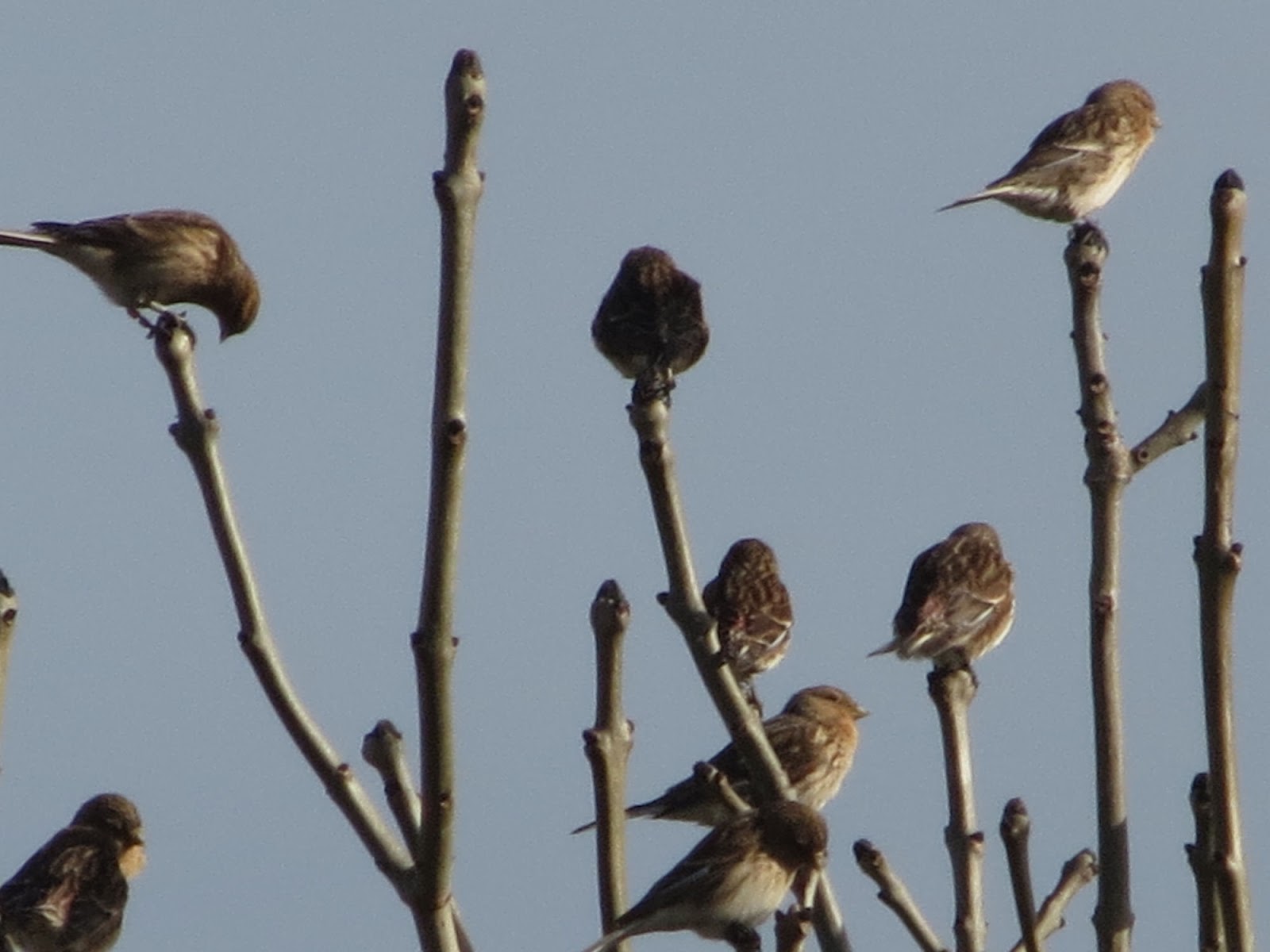
One of the benefits of modern technology is abundant reports of interesting bird - a big thank you to all those who post on BirdForum.net and and DeeEstuary.co.uk! This last weekend brought another trip for a relative rarity, this time to Flint Castle on a hunt for a flock of Twite. The day started well with a fly-by from a Raven, but then brought frustration; a noisy series of passes by a flock of small birds going up and down the salt marsh, wheeling around. Almost certainly the reported Twite, but they were too distant to be seen clearly, and were reluctant to settle for more than a moment or two.
Gradually the flock came closer, and more could tantalising be seen; the alternating flash of almost white underneath, and a brown on top, longish tails with a distinct 'v' at the end. A delight in aerobatics, but still too fast to see clearly. Attempts to get a photo were frustrating, to say the least.
Then finally they settled on the top of some small trees, and there was a chance to grab some shots. Still from a distance, not wanting to set them off again. Only later, zooming the pictures, do we see a little pink patch on the base of the back. Yup, some very flitey Twite!
Just as we are about to head off, we see a little bird land on a patch of sand (right behind a group of birders watching the twite) - finally we get a glimpse of a delightful bird that we've been hunting for the last few months; while not rare, the Grey Wagtail is not seen as often as it's more common relative, the Pied Wagtail. We perhaps should not have been surprised, wagtails often being seen on beaches, and on their urban equivalent - car parks! A real pleasure to see, bringing smiles all round.
Beautiful, but as we descended back to the car the rain began to set in - time to rapidly escape to the (relative) warmth of the cafe at the RSPB reserve at Conwy. After a very tasty (if slightly dear) plate of welsh rarebit and a large mug of tea, we explored the reserve, watching the Teal and Pochard. Hiding beside one pool we found this chap hunched up, waiting for lunch to come swimming by.
As we enter one hide we're treated to a swim past by a pair of Red-breasted Mergansers; here's the male, a very delicate looking bird - the photo doesn't really do justice to the colours. The female is a duller colour, but just as delicate in shape. These are divers, and on a still day they can be tracked by the stream of bubbles.
Right by the entrance is a sparrow house with style - I'd love to have one of these in the garden, thought the neighbours may disagree!
The following weekend brought a trip to Astbury Country Park, near Congleton, to try and find a visitor that had been reported for last couple of weeks - a Slavonian Grebe. As we walked around the mere, binoculars in hand, we kept being stopped by locals - "Are you here to see the Grebe? It's just round that corner"... It took us ages to get there because of the number of times we were stopped! Still, it was good to see so many non-birding locals taking an interest in what was happening in their neck of the woods - perhaps some of them will have had the seed sown... Anyway, we eventually rounded the corner and met the Slav. Really quite a small and delicate bird, also a diver, but the colour was unmistakeably - again, the photo doesn't do justice to this silver-grey/white bird, with it's vivid red eye.
One of the benefits of modern technology is abundant reports of interesting bird - a big thank you to all those who post on BirdForum.net and and DeeEstuary.co.uk! This last weekend brought another trip for a relative rarity, this time to Flint Castle on a hunt for a flock of Twite. The day started well with a fly-by from a Raven, but then brought frustration; a noisy series of passes by a flock of small birds going up and down the salt marsh, wheeling around. Almost certainly the reported Twite, but they were too distant to be seen clearly, and were reluctant to settle for more than a moment or two.
Gradually the flock came closer, and more could tantalising be seen; the alternating flash of almost white underneath, and a brown on top, longish tails with a distinct 'v' at the end. A delight in aerobatics, but still too fast to see clearly. Attempts to get a photo were frustrating, to say the least.
Then finally they settled on the top of some small trees, and there was a chance to grab some shots. Still from a distance, not wanting to set them off again. Only later, zooming the pictures, do we see a little pink patch on the base of the back. Yup, some very flitey Twite!
Just as we are about to head off, we see a little bird land on a patch of sand (right behind a group of birders watching the twite) - finally we get a glimpse of a delightful bird that we've been hunting for the last few months; while not rare, the Grey Wagtail is not seen as often as it's more common relative, the Pied Wagtail. We perhaps should not have been surprised, wagtails often being seen on beaches, and on their urban equivalent - car parks! A real pleasure to see, bringing smiles all round.
Now, where's that Kingfisher ?!?!
Subscribe to:
Posts (Atom)